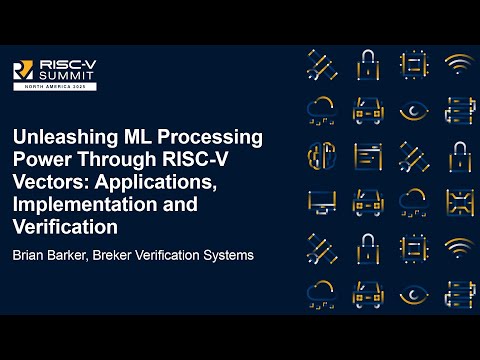
Unleashing ML Processing Power Through RISC-V Vectors: Applications, Implementation and...
summary
RISC-V Vector means big state and tricky verification: 32 vector registers, 7 CSRs and ~200 instructions and algorithmic scaling where VLmax scales across architectures so the same code handles 16 elements on VL=128 or 256 elements on VL=2048. Implementation forces SIMD lanes, mask-as-register duality, and load/store coherency headaches. Verification uses a graph-based cover-point generation that expands dimensions into paths and drives constrained stimulus and memories. An assembly test case runs with two software threads plus one hardware thread and emits pass/fail logs.
AI-written summary · about
chapters (9)
- 0:00Introduction to RISC-V vectors
- 1:02Why SIMD matters for ML
- 2:04RISC-V vector basics
- 3:27Algorithmic scalability in vectors
- 4:11Vector load/store complexities
- 7:20Verification challenges with vectors
- 8:44Implementation features overview
- 10:53Coverage-driven verification approach
- 11:57Example test case demonstration
related talks
 34mRISC V Vector Extension Proposal
 13mKeynote: Taking RISC-V Intelligence Everywhere
 01h 45mPorting SIMD to RISC-V Vectors | Corrected Audio
 01h 45mPorting SIMD to RISC-V Vectors
 11mSimulate, trace, and evaluate a RISC-V system leveraging very long vectors
 10mLightning Talk: Software Development for ML and RISC-V Vector Acceler...
 12mDemo: Boosting AI on Semidynamics RISC-V Cores with Custom Tensor Instructions
 10mAvoiding Amdahl's Law RISC-V Architecture Exploration for AI & ML Compute