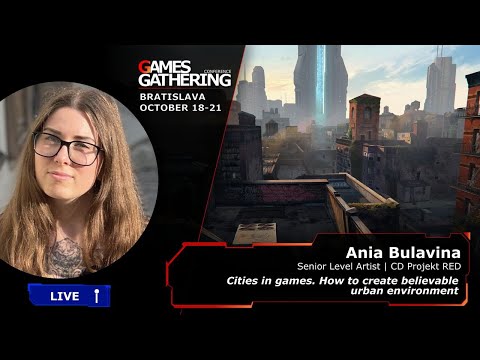
Cities in games. How to create believable urban environment
summary
Main claim: a playable city is a system of rules and readable spaces not just buildings. Urban design starts in preproduction with heavy research, simple cube layouts and a street grid, then defines Street, Square, Backyard, green zones per neighborhood. Three practical parameters drive decisions: size, scale, level of detail (movement type sets scale and LOD; eg. driving needs larger 5x5 km-style scope, walking needs dense compact blocks). Use references, design landmarks, vary layout and architecture, and adjust real maps to gameplay rather than copying them.
AI-written summary · about
chapters (19)
- 0:00Introduction
- 3:52Why cities matter
- 5:41Common city mistakes
- 9:14Urban space types
- 15:18City structure for games
- 17:23Street grids for level design
- 19:29Pure spatial cubes
- 25:13City creation basics
- 30:53Visual diversity in neighborhoods
- 37:23Street grid and master plan
- 44:51Rules for believable cities
- 45:34Q&A
- 46:15Copying real city layouts
- 48:21Favorite virtual city
- 48:41City planning workflow
- 51:57Collaboration with mission designers
- 53:21Most interesting project
- 56:02Rules for futuristic/historical cities
- 57:30Medieval vs modern cities
related talks
 18mResolving complex urban challenges with gaming
 56mDesigning the Cities of Skyrim
 54mWorld Building pipeline of Dying Light 2.
 45mTips and Tricks on Developing an Open World Game
 35mCreating Alstom's Virtual City
 35mCyberpunk 2077 and the Architecture of Control: The City as a Playable System of Power
 15mGaming the Future of Architecture
 51mBuilding Better Worlds through Game Culturalization