Speeding up Game Logic in Unreal Engine

summary
Claims an ECS-style framework called FGL that stores small USTRUCT POD components in contiguous pools, schedules processors via an extended taskgraph with automatic batching and access-pattern locking, and adds views, tags and threaded-writes for safe parallelism. Measured on a radius-check demo: vanilla Unreal tick runs 6.8s, contiguous-memory single-thread FGL cuts that by 99% to 66.6ms, SpatialHash drops to 19.5ms, and full WorkerThreads reach ~6ms. Integration hooks modify UnrealHeaderTool, add an FReplicator proxy for replication, and provide Blueprint-accessible FGL ticks; system is built and effective.
AI-written summary · about
chapters (19)
- 0:00The bottleneck of game logic
- 0:56Unreal Engine ticking issues
- 2:29Entity Component System
- 4:43Conan Exiles performance case
- 6:14Designing the FGL framework
- 9:34Using views and tags
- 11:44Processor logic and scaling
- 14:26Damage processor example
- 16:41Registration and parameters
- 18:54Performance insights
- 21:30Component pool management
- 24:25The simulation exercise
- 26:00Comparing performance results
- 27:35Spatial hash map impact
- 28:45Unreal Engine integration
- 30:44Handling waterfalls and RPCs
- 31:42Networking and replication
- 32:29Blueprint integration
- 33:53Lessons learned and conclusion
related talks
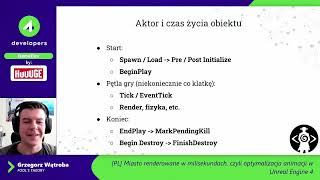 43mOptimizing animations in Unreal Engine 4
 01h 03mMaximizing Your Game's Performance in Unreal Engine
 44mPanel - UE4 Pipelines, Teams and Tools
 01h 00mUnreal Engine Game Optimization on a Budget
 36mImproving Developer Iteration in Unreal Engine 5
 38mGrowing a Healthy UE4 Ecosystem
 51mOptimising Games for a Complex World
 41mBeyond OOP: A Journey From Cache Misses to MASS Hits