RISC-V enabled, low-power CNN classification in Edge devices
summary
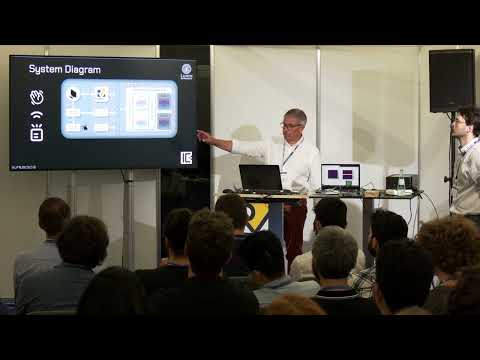
A pulse-coherent radar produces streaming matrices that feed two small CNNs (distance and phase/velocity) running on a programmable near-memory computing co‑processor attached to a RISC‑V MCU; an FPGA demo reproduces a planned 22 nm die and shows a 98% CPU offload versus doing inference on the core, claiming large power savings. JTAG is used for demo connectivity today (SPI/real sensor integration and final power numbers pending).
AI-written summary · about
chapters (6)
- 0:00Introduction and demo overview
- 2:07Application and radar sensor
- 3:51System architecture and co-processor
- 5:45CPU offload and power saving
- 7:11Dual neural networks explanation
- 8:19Collaboration and Q&A invitation
related talks
 17mNext-Generation Edge AI with RISC-V Vector Cores for Vision Applications
 13mAdding A Binarized CNN Accelerator To RISC V For Person Detection
 13mKeynote: Taking RISC-V Intelligence Everywhere
 19mAccelerating Edge AI with the Help of RISC-V
 06mEmbedded Executive LIVE
 09mA Tightly Coupled Light Weight Neural Network Processing Units With RISC V Core
 14mKeynote: RISC-V Opportunities at the Edge of AI
 12mCustomizing RISC-V Cores to Accelerate Neural Networks