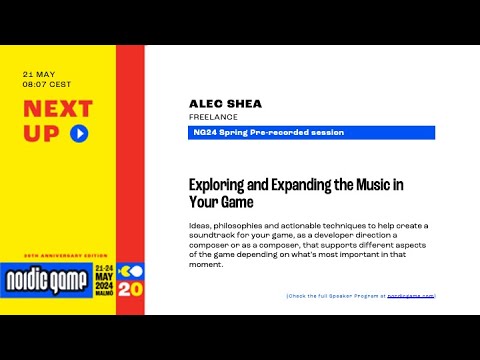
Exploring and Expanding the Music in Your Game
summary
Argues that music should map to world, character, or narrative and gives concrete outcomes: a psychological game ships with ambient grunge and math rock, dark electronic, orchestral peaks and horror soundscapes; an animated series assigns distinct genres per character and solves cohesion by adding electronic drums glue to divergent tracks; an opening theme is composed one month before release and becomes the standout; recommends explicit composer–developer briefs and that it’s never too late to add styles.
AI-written summary · about
chapters (12)
- 0:00Introduction
- 1:03Musical concepts for games
- 2:05Music and game design
- 3:49Boss fight music approaches
- 5:56Corpse Factory soundtrack examples
- 10:36Character-driven music in Aro series
- 12:39Biome music in economics
- 14:46Expanding late soundtracks
- 17:00Musical challenges and mistakes
- 18:25Key takeaways
- 20:12Favorite soundtracks
- 21:36Final caveats and Q&A
related talks
 24mMusic Design and Implementation
 01h 00mSynch. How to find music for your game!
 32mThe Hidden Language of Game Music | Building Worlds Through Sound
 33mNavigating the Emotional Flow of Gameplay
 15mUnpacking the Audio Game Experience: Lessons Learned from Game Veterans
 11mSound Design
 21mHow to lay the foundations for compelling storytelling in games
 06mGame Atmosphere: Effects of Audiovisual Thematic Cohesion on Player Experience and Psychophysiology