Making Sense of Sleep: Multimodal Sleep Stage Classification in a Large, Diverse Population ...
summary
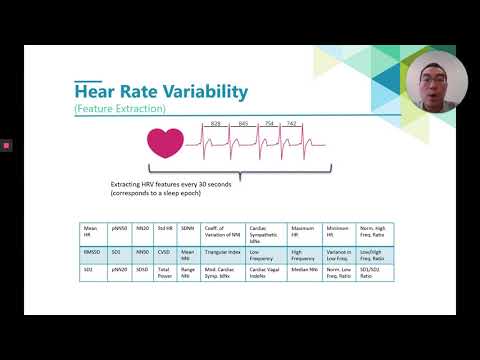
Study uses multimodal actigraphy and ECG from 1,743 participants to extract 370 activity statistics and HRV features per epoch, aligns RR intervals with activity, and trains CNNs and LSTMs (single-layer benchmarks) plus an ensemble. CNNs win sleep-wake, LSTMs excel for finer sleep-stage sequences, and the ensemble reaches 78.2% accuracy and 69.8% F1 on three-stage classification. SHAP on Random Forest identifies cardiac frequency features as key; code and data are on the linked GitHub.
AI-written summary · about
chapters (11)
- 0:00Intro
- 0:27Normal Sleep Cycles
- 0:49Measuring Sleep
- 1:24Dataset Description
- 1:44Data Processing Pipeline
- 2:12Actigraphy
- 2:50Single Modality and Multimodality Modeling
- 3:23Evaluation Method
- 3:50Three Stages Sleep Classification
- 4:41SHAP Feature Importance - 1
- 5:05It's an Open Source Project
related talks
 13mEnhanced EEG Data Classification with 3D SNN and On-Line Learning ESN
 28mCan we measure depression
 19mClosing Keynote
 26mBrainDrain Using Machine Learning and Brain Waves to Detect Errors in Human
 28mHow Smart is the ECG? Lessons from Advanced ECG Analytics
 19mInTheMoodForLife: Analyzing Sleep to Better Manage Mood Disorders
 28mDeep Learning-Based Human Activity Recognition for Physical Skills...
 06mUnsupervised Human Activity Representation Learning with Multi-task Deep Clustering