Let Me Be Implicit: Using Motive Disposition Theory to Predict and Explain Behaviour in Digital ...
summary
An experiment with 109 players in 30-minute groups of three in Minecraft social play uses projective coding of implicit motives and coded chat plus peer likability ratings to link motives to behavior. Main claims: implicit affiliation motive predicts in-game social actions (more favorable ratings, specific chat patterns) while explicit motives correlate with questionnaires; implicit affiliation adds significant variance to regression models even after controlling for personality, explicit affiliation, self-esteem, and social traits. Coding is manual and time-consuming.
AI-written summary · about
chapters (8)
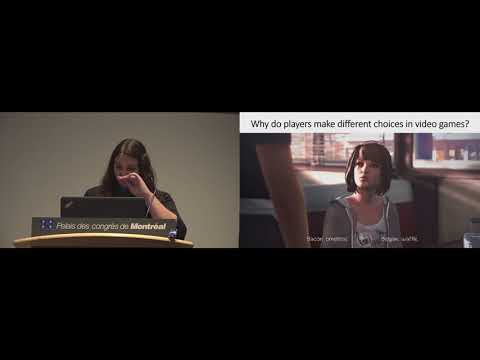
- 0:00Introduction to player choices
- 1:51Motive disposition theory
- 3:24The four core motives
- 5:13Behavioral strategies
- 7:20Study methodology
- 9:38Results and findings
- 13:04Conclusion and implications
- 15:16Q&A session
related talks
 16mThe Role of Uncertainty in Moment-to-Moment Player Motivation: A Grounded Theory
 08mInvestigating Players' Perceptions of Deceptive Design Practices within a 3D Gameplay Context
 08mThe Consistency of Gamification User Types: A Study on the Change of Preferences over Time
 34mGames ≠ Subjective: How to craft engaging experiences by knowing your players
 03mExploration of Player Emotions, Behaviours, and Individual Differences across Game Difficulty...
 06mA Cheating Mood: The Emotional and Psychological Benefits of Cheating in Single-Player Games
 58mMoral Choice in Video Games: Creating Experiences That Make Players Think
 05mThat’s the way I (dis-)like it! – Effect of Gamer Types and Competitiveness in VR Exergaming