A Visual Interaction Cue Framework from Video Game Environments for Augmented Reality
summary
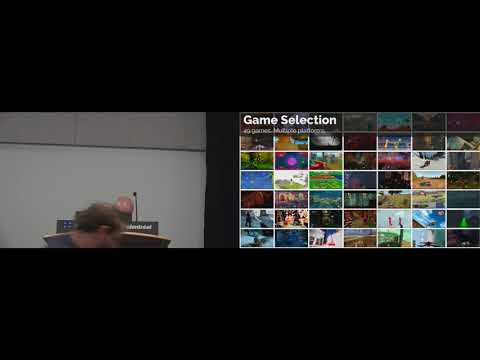
Paper presents a descriptive framework derived from 49 games analyzed that classifies visual interaction cues along three dimensions: purpose (three tasks: discover, look, go), markedness (styling: subtle, emphasized, integrated, overlay), and trigger (player/context/agent/persistent); includes a library prototype that implements discover cues as a worn sticker, a flashing particle wrap, a floating 3D arrow, and an overlay mini‑map, and shows how game cue patterns map directly to AR design choices.
AI-written summary · about
chapters (7)
- 0:00Introduction and motivation
- 2:11Video game guidance inspiration
- 5:18Framework creation process
- 7:12Framework dimensions explained
- 12:28Prototype application design
- 15:16Future work and challenges
- 15:58Q&A session
related talks
 07mMove, React, Repeat! The Role of Continuous Cues in Immersive Exergames
 10mSpatial Augmented Reality Visibility and Line-of-Sight Cues for Building Design
 08mVirtual Objects as Spatial Cues in Collaborative Mixed Reality Environments: How They Shape ...
 19mThe Unspoken Challenges of AR & VR
 26mIEEE CoG 2019 - Industry Day - Theresa Duringer (Temple Gate Games)
 08mPerception and interaction design
 03mComputer-based Deceptive Game Design in Commercial Virtual Reality Games: A Preliminary Investiga...
 09mAdvanced Augmented Reality interactions