Designing Pronunciation Learning Tools: The Case for Interactivity against Over-Engineering
summary
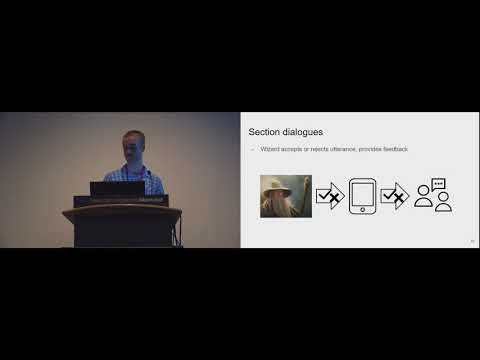
Researchers embed a pronunciation error detector in a Wizard of Oz paired role-play with 36 absolute-beginner French learners and compare three conditions: baseline, a published state-of-the-art PED, and a heuristic PED that ranks word difficulty offline and needs no audio. Pronunciation improves across sessions regardless of PED; group dynamics explain far more variance (random‑effect SD ≈ 0.46 on a 1–5 scale) than the tiny PED effect (≈0.08). Cohen’s kappa shows the heuristic matches wizard labels more but functional impact is negligible.
AI-written summary · about
chapters (9)
- 0:00Start
- 4:56What we're doing
- 6:14Experimental design
- 6:45Section dialogues
- 8:32Experimental conditions
- 9:29Evaluation
- 10:40Pronunciation scores
- 12:48Implications
- 14:01The case for interactivity
related talks
 16mUser Interaction Models for Disambiguation in Programming by Example
 59mDesigning for speech
 23mAn Interactive Learning Environment for Program Design
 21mA Human-in-the-Loop System for Sound Event Detection and Annotation
 11mThe Unreasonable Effectiveness of Prompt Learning
 08mInterview of Emmanuelle Aboaf
 14mTalking Spell: A Wearable System Enabling Real-Time Anthropomorphic Voice Interaction with Everyd...
 01h 04mBuilding Expertise Into Generated Conversations