Open Source Chip Design in the European Semiconductor Strategy

summary
Europe now has an end-to-end open source chip: Basilisk SoC is taped out in IHP 130 nm BiCMOS, uses a CVA6 core, runs Linux and publishes GDS2 and RTL. The flow uses open tools (OpenROAD, Yosys and friends) and validated manufacturing at IHP. Google/SkyWater’s 130 nm PDK and the Tiny Tapeout service enable affordable runs. A €20M EU call (matched to €40M total) funds digital, analog and productivity tooling.
AI-written summary · about
chapters (12)
- 0:00Introduction and background
- 1:20Open source silicon overview
- 2:58Chip design ambitions in Europe
- 5:35Open source roles in RISC-V
- 9:18Categorizing open source design
- 12:38Challenges in hardware design
- 14:10Education and talent development
- 18:12Open source design IP and EDA
- 20:41Strategic funding and roadmaps
- 23:38Policy actions for European chips
- 27:34Manufacturing and access
- 29:42Demystifying chip design
related talks
 16mOpen-source silicon chips
 18mOpen source chip design: for fun and for profit
 26mFrom Tapeouts to Products: Why Open-Source Silicon Must Solve Real Problems to Survive
 14mOpen Source Hardware: Hacking Silicon for Fun (instead of profit)
 41mRISC-V and Open Source Hardware Projects BoF
 19mFrom an Open-Source ISA to Open-Source HW to Open-Source Silicon
 40mOpen-Source HW Commercial Adoption: Lessons Learned
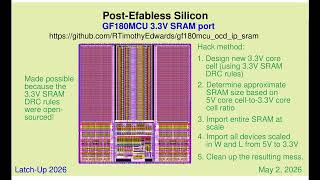 19mPost-Efabless Silicon on SkyWater, GlobalFoundries, and IHP