From Tapeouts to Products: Why Open-Source Silicon Must Solve Real Problems to Survive

summary
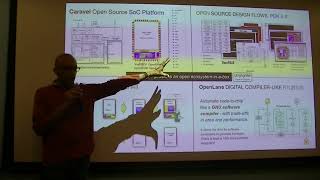
Argument: open-source silicon survives only when it ships in real products with product-grade constraints and revenue. Claims include that the toolchain is ready—open PDKs, automated RTL-to-GDSII and a proven SoC harness exist—and the ecosystem already has three foundries with open PDKs, Tiny Tapeout/Chip Bounty programs, and shared shuttles. Concrete results: a Strive chip powers up (end of 2020), SkyWater 130 open analog blocks exist but need testing, and a text-to-GDS flow from Native Chips demonstrates AI-generated microcontrollers; economics (e.g. 100 units ≈ $15k) and 50,000 potential small product customers motivate shipping.
AI-written summary · about
chapters (18)
- 0:00Introduction
- 1:02Open-source silicon community
- 2:47Open-source chip ecosystem
- 3:50Open-source silicon products
- 5:54Tapeouts vs market products
- 7:42Opportunities for small companies
- 8:44Product pipeline with open silicon
- 9:46Chip Bounty initiative
- 11:10AI in chip design
- 13:05Q&A: Funding gap
- 15:14Q&A: Volume drivers for PDKs
- 16:58Q&A: Industrial validation
- 18:00Q&A: Prioritizing gaps
- 19:47Q&A: 3G radios testing
- 21:32Q&A: Scaling tools
- 24:24Q&A: AI tool improvement
- 25:06Q&A: Fully open-source chip
- 25:27Summary
related talks
 16mOpen-source silicon chips
 15mBuilding an Open Source Hardware Ecosystem: From Foundations to Rooftops
 40mOpen-Source HW Commercial Adoption: Lessons Learned
 14mOpen Source Hardware: Hacking Silicon for Fun (instead of profit)
 04mWhere Community Powers Innovation
 33mOpen Source Chip Design in the European Semiconductor Strategy
 18mOpen source chip design: for fun and for profit
 17mOpen-Source HW Commercial Adoption: Lessons Learned