Oxbow: A Coordinated Architecture for Multi-Component File Systems
Talkat 20th USENIX Symposium on Operating Systems Design and Implementation (OSDI '26) · 2026-07-13..07-15·
summary
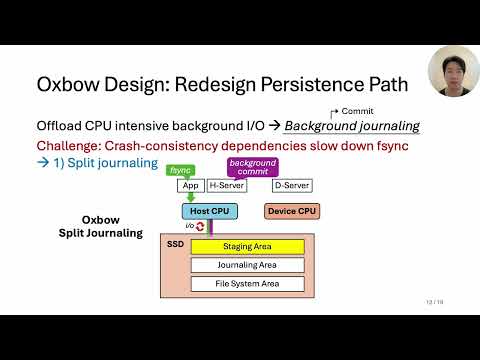
Oxbow builds a three-part file system (user daemon, kernel ufs, device server) that routes reads through the kernel and sends writes directly to a computational SSD, implements Split Journaling with a staging area and DMA snapshots, and shares metadata via shared-ownership metadata in shared memory to avoid copies. Evaluated on an emulated Bluefield DPU + Samsung SR-IOV SSD using LWxt4, it beats a user-level UFS by up to 86% throughput and yields the highest host CPU efficiency.
AI-written summary · about
chapters (15)
- 0:00Oxbow file system intro
- 1:04Traditional storage limits
- 2:49Performance vs CPU tradeoffs
- 3:51Device FS drawbacks
- 4:57Motivation for coordination
- 5:18Oxbow coordinated design
- 7:08Data path optimizations
- 8:55Metadata overhead reduction
- 9:59Offloading background ops
- 11:49Split journaling
- 13:13Evaluation setup
- 14:18Write workload results
- 15:41Read workload results
- 16:26Host CPU efficiency
- 17:07Conclusion
related talks
 43mNVM Software Interfaces New Direction
 01h 01mRacing The File System
 51mWhat went wrong with AIO
 24mIpecac for the Ouroboros
 32mA Fork to Reckon With: Minimizing Friction When Adopting OSS
 26mTackling High-Reliability, High-Performance Systems on Linux — A Japanese-Style OSS Collaboration to Win Global Competition
 48mDesign of data-intensive applications
 24mOscar: A Practical Page-Permissions-Based Scheme...