Mimesys: Generating Realistic Executable Testing Environments from Resource Usage Traces
Talkat 20th USENIX Symposium on Operating Systems Design and Implementation (OSDI '26) · 2026-07-13..07-15·
summary
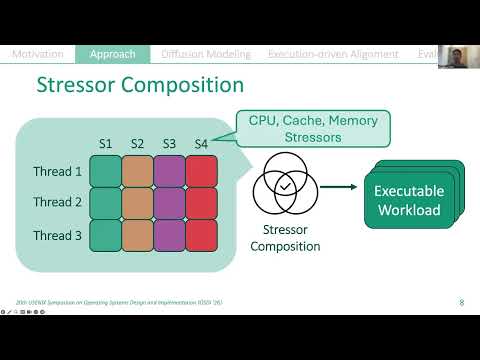
Mimesys converts time-series resource traces into executable stressor compositions represented as a per-thread 2D grid of fractional run times and pins threads to cores to get a precise hardware footprint. It trains a diffusion-based generative model with state-aware conditioning on prior stressor state, then fine-tunes via execution-driven alignment (RL) using trace-similarity reward from real runs. Uses stress-ng and Google Fit Bench stressors, reproduces 5-hour traces with up to 5.5× higher similarity and matches performance impact 2.6× more accurately (TPCC on Silo).
AI-written summary · about
chapters (10)
- 0:00Mimesys introduction
- 1:44Noisy neighbor problem
- 3:54Limitations of synthetic workloads
- 5:20Generating executable workloads
- 7:07Mapping traces to stressors
- 9:35Execution alignment for apps
- 10:41Evaluation setup
- 12:28Trace similarity results
- 13:11Performance impact of neighbors
- 13:52Summary and future
related talks
 42mStress Testing and Micro Benchmarking Kernels with Stress-ng
 19mMaking Sense of Multi-Threaded Application Performance at Scale with NonSequitur
 33mCyclic Tests Unleashed: Large-Scale RT Analysis with Jitterdebugger
 33mReward Stress Tests for Agentic Post-Training with Ray
 42mExercising the Linux scheduler with Yogini
 19mrtesbench: A Multi-core Benchmark Framework for Real-Time Embedded Systems
 27mReal-time Testing with Fuego
 15mFoundations of Empirical Memory Consistency Testing