NVM Software Interfaces New Direction
summary
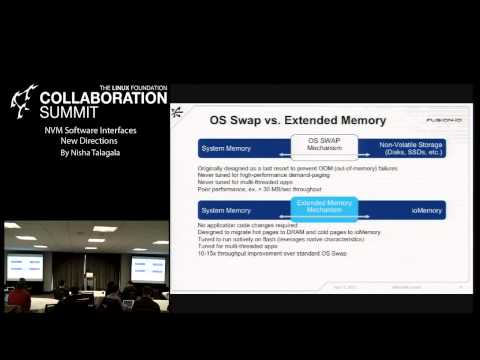
Fusion io builds and tests new NVM software: a kernel module exposing physical persistent pages, a small file system called DirectFS (8–9k LOC) and I/O/memory primitives pushed to T10 and open source. Atomic write support integrates into MariaDB/Percona and cuts application write amplification roughly in half. DirectFS runs within 2–5% of raw device throughput. Putting logs on tiny persistent memory doubles DB commit throughput and approaches “logs off” speed; one core drives ~9–10M updates to persistent pages. Swap patches on GitHub keep tiering DRAM↔flash paced with three fast devices.
AI-written summary · about
chapters (15)
- 0:00Introduction
- 1:03Flash
- 5:57IO Semantics
- 9:50Atomic Rights Example
- 10:24Atomic IO Example
- 13:19Native File System
- 15:46Direct FS
- 19:33Primitive Performance
- 20:10Supporting KV Applications
- 22:10Performance Comparison
- 23:15Memory Access
- 25:16Extended Memory
- 26:55Extended Memory Programming Model
- 29:58Persistent Memory
- 42:14Blockio Stack
related talks
 18mHarvesting Idle Memory for Application-managed Soft State with Midas
 18mOxbow: A Coordinated Architecture for Multi-Component File Systems
 22mFungible Memories for Automated Technology Mapping and Retargeting
 48mDesign of data-intensive applications
 31mAerospike Today and Tomorrow: Our Roadmap
 01h 01mRacing The File System
 16mNetVRM: Virtual Register Memory for Programmable Networks
 22mvNV-Heap: An Ownership-Based Virtually Non-volatile Heap for Embedded Systems