Design your own custom co-processors and acceleration hardw

summary
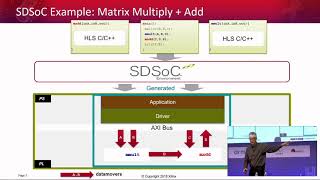
Course outlines how to prototype custom accelerators on an Ultra96 board using SDSoC and the PYNQ-like Python framework, with concrete results: a matrix‑multiply accelerator runs ~24x faster at 100 MHz and ~38x at 300 MHz versus CPU, limited by AXI data movement rather than fabric clock. It demonstrates bitstream reloads under a second (SRAM‑based, effectively unlimited), points to Adam Taylor projects, element14 reference designs and hands‑on Ultra96 v2 training.
AI-written summary · about
chapters (13)
- 0:00Intro
- 1:21Co-Processing History
- 3:37Co-Processors and Acceleration Hardware
- 6:39Programmable Logic - What is it?
- 10:05A REAL Example
- 11:11What is going on behind the curtain?
- 25:00Blogs and Projects
- 27:07Documentation
- 32:05Reference Designs
- 39:05Ultra96-V2 Kit Overview
- 40:01Ultra96-V2 Block Diagram
- 42:42Microchip ATWILC3000 Pre-Certified Countries
- 43:29Ultra96 - Xilinx Programmable Logic Advantage
related talks
 59mDramatically Accelerate 96Board Software via an FPGA with Integrated Processors
 29mAll Programmable SoCs?
 16mBuild your own Open Hardware CPU in 25 minutes or less
 24mUniversal Tools for Acceleration, Timing, Integration & Machine Enhancement
 23mRunning an Open Source LLM on Open Source Hardware
 43mSoftware Development Trends for FPGAs
 22mDemo: From Blueprint to Reality: Navigating SoC Tradeoffs, IP, and Ecosystem
 35mMulti-core Application Development with Zephyr RTOS