Modeling the Impact of Depth on Pointing Performance

summary
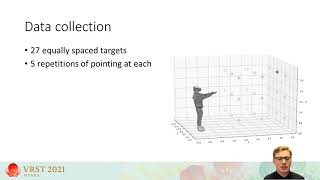
Experiment measures mid-air distal pointing at 110, 220, 330 cm using active stereo tracking (Vicon/Wii remote and Eyecon cameras) and compares physical versus rendered depths. Main claims: two-part Welford model predicts movement time better as distance increases, K-factor varies with depth in a monotonic but not-proven-linear way, and virtual depth differs from physical — VR calibration changes K slopes and intercepts. Angular index metrics do not improve global fits; three distances limit conclusions about linearity.
AI-written summary · about
chapters (16)
- 0:00Start
- 0:05Modeling The Impact of Depth on Pointing Performance
- 0:39Connection To Virtual Reality
- 1:12Overview and Contributions
- 1:37Pointing Models
- 2:12Gain and the K-Factor
- 3:07Angular Measures Kopper 2010
- 3:49Research Questions
- 4:21Apparatus
- 4:38Study Design
- 5:15Does Welford Improve Modelling?
- 6:35Separability of A and W
- 8:11Is K Variation the Same For VR?
- 9:50Do Angular Measures Fix Fitts?
- 11:21Summary
- 13:05Key Take Aways
related talks
 06mModeling Pointing for 3D Target Selection in VR
 18mDepth Conflict Reduction for Stereo VR Video Interfaces
 11mExtendlibur: Dynamic Haptic Retargeting for Length-Mismatched Proxies in Co-Located VR
 08mThe Effects of Hand Representation on Experience and Performance for 3D Interactions in Virtual R...
 22mPinpointing: Precise Head- and Eye-Based Target Selection for Augmented Reality
 18mDrift-Correction Techniques for Scale-Adaptive VR Navigation
 12mVR Side-Effects: Memory & Proprioceptive Discrepancies After Leaving Virtual Reality
 20mSuperiority of a Handheld Perspective-Coupled Display in Isomorphic Docking Performances