EyeGrip: Detecting Targets in a Series of Uni-directional Moving Objects Using Optokinetic ...

summary
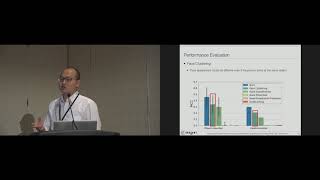
EyeGrip automatically flags which horizontally or vertically scrolling item a viewer is attending to by detecting extended smooth pursuit segments in the optokinetic nystagmus signal captured with a head‑mounted eye tracker. A 20‑person study (5 excluded) tests three speeds, two image sizes, 40 images per run with 7 targets, and uses the horizontal pupil coordinate and a Multilayer perceptron in WEKA with 20–30 frame windows to classify peaks, reaching 87% accuracy in the lab, 81% in a picture selector, and 100% in a mind‑reading demo; speed and visible count determine usability.
AI-written summary · about
chapters (12)
- 0:00Introduction and overview
- 0:26Scrolling and EyeGrip concept
- 1:34How EyeGrip detects interest
- 4:45Experiment setup and conditions
- 7:14Error rates and participant data
- 7:58Classifier evaluation process
- 9:27Accuracy results and findings
- 10:35Design guidelines for EyeGrip
- 11:59Sample applications overview
- 13:22Mind reading game demo
- 14:04Potential applications
- 15:09Summary and conclusion
related talks
 19mEyeScout: Active Eye Tracking for Position and Movement Independent Gaze Interaction with Large ...
 19mEveryday Eye Contact Detection Using Unsupervised Gaze Target Discovery
 09mUsing Gaze Behavior and Head Orientation for Implicit Identification in Virtual Reality
 19mGazeProjector: Accurate Gaze Estimation and Seamless Gaze Interaction Across ...
 20mEye-tracking and AI: Unveiling the Limitations and Synergies
 21mSelf-Calibrating Head-Mounted Eye Trackers Using Egocentric Visual Saliency
 48mEye Tracking (a Deep Learning Approach)
 22mPinpointing: Precise Head- and Eye-Based Target Selection for Augmented Reality