Investigating Effects of Post-Selection Feedback for Acquiring Ultra-Small Targets on Touchscreen
summary
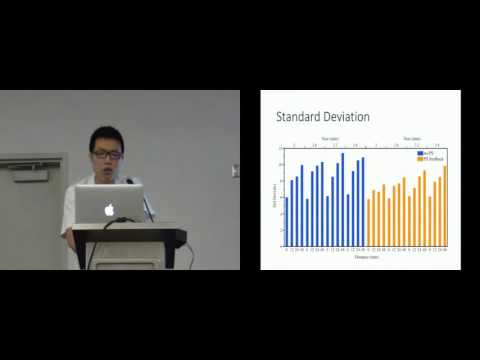
Three staged experiments on smartphones and a smartwatch test a ripple post-selection visualization that shows the finger’s contact point after lift for 2–4 mm targets. Results: average error rate falls from ~44% to ~10% (overall reduction reported 78.4%), systematic offset drops >74% and standard deviation drops ~32%, first-experiment selection time rises 9.7% but smartwatch trials finish faster (900 ms vs 1.5 s) due to fewer retries, and touch adjustments become more accurate (regression slopes move toward −1).
AI-written summary · about
chapters (18)
- 0:00Intro
- 0:30Background: Tiny Targets (2-4 mm)
- 1:20Post-Selection Feedback
- 2:03Touch is Inaccurate!
- 3:37Standard Deviation
- 4:56Motivation
- 6:22Crosshair Target
- 7:14Results of Exp. 1
- 8:14Subjective feedback
- 8:44Reciprocal task
- 9:07Error Rates
- 9:36Systematic Offset
- 12:20Summary of Three Experiments
- 13:34Correlation between dx and dx
- 14:17Positive Adjustment (Ratio)
- 14:35Positive Adjustment Ratio dx
- 15:53Mean Results
- 16:08Conclusion
related talks
 12mTouchscreens in Motion: Quantifying the Impact of Cognitive Load on Distracted Drivers
 19mDoes Practice Make Perfect? Learning to Deal with Latency in Direct-Touch Interaction
 19mPredicting Finger-Touch Accuracy Based on the Dual Gaussian Distribution Model
 17mNext-Point Prediction for Direct Touch Using Finite-Time Derivative Estimation
 17mPointing Forward (updated)
 19mInvestigating the Use of Spatial Interaction for 3D Data Visualization on Mobile Devices
 17mJetto: Using Lateral Force Feedback for Smartwatch Interactions
 20mNext-Point Prediction Metrics for Perceived Spatial Errors