DualKey: Miniature Screen Text Entry via Finger Identification
summary
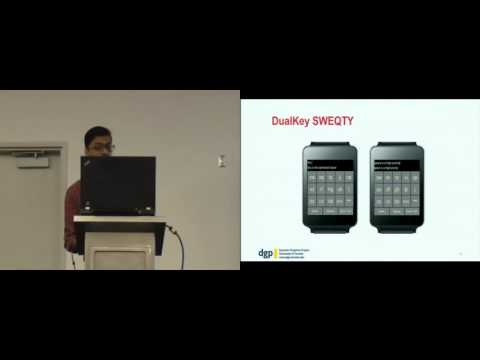
A finger-identified smartwatch keyboard doubles key size by mapping left/right letters to index versus middle taps, using an optical sensor on the finger for identity and an implemented prototype. A 10-day study with 10 participants reaches 19.6 WPM long-term and 6.3% total error; a layout optimization (SWEQTY) tuned to reduce finger switches runs a second 10-day study (8 participants) and yields SWEQTY 21.59 WPM with error rates roughly half QWERTY.
AI-written summary · about
chapters (12)
- 0:00Introduction to DualKey
- 0:47How DualKey works
- 1:53Drawbacks of existing techniques
- 4:03Prototype and study design
- 5:11Study results and performance
- 6:58Comparison with existing keyboards
- 8:04Finger switching analysis
- 9:27Optimizing keyboard layout
- 10:33SWEQTY layout results
- 11:58Future work and open questions
- 13:01Design takeaways for finger ID
- 14:27Q&A session
related talks
 20mTipText: Eyes-Free Text Entry on a Fingertip Keyboard
 12mEvaluation of Korean Text Entry Methods for Smartwatches
 20mDriftBoard: A Panning-Based Text Entry Technique for Ultra-Small Touchscreens
 21mThe Impact of Word, Multiple Word, and Sentence Input on Virtual Keyboard Decoding Performance
 18mTyping on a Smartwatch for Smart Glasses
 18mImproving Virtual Keyboards When All Finger Positions Are Known
 08mTypeBoard: Identifying Unintentional Touch on Pressure-Sensitive Touchscreen Keyboards
 21mCOMPASS: Rotational Keyboard on Non-Touch Smartwatches