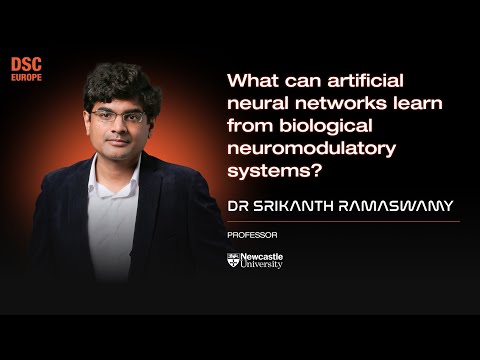
What can artificial neural networks learn from biological neuromodulatory systems?
summary
Presents a dual framework that builds detailed biophysical cortical microcircuit models and distills them into layered recurrent spiking networks; implements dopamine-modulated STDP and neuromodulator effects on spiking modes. Tests use an ~3,000-neuron recurrent network (≈100 synapses/neuron, 4:1 E:I) with inhibitory heterogeneity; a 70% fast / 30% accommodating inhibitory mix maximizes reinforcement learning speed. Adding 20% bursting excitatory cells speeds learning but destabilizes it. Neuromodulators (dopamine, noradrenaline, acetylcholine) are simulated as switches that trade off fast learning versus long-term stability.
AI-written summary · about
chapters (11)
- 0:00Introduction
- 0:47Neuromodulation in biology
- 3:39Neuromodulators and brain states
- 7:35Gaps in neuromodulation
- 9:40Neural diversity comparison
- 11:27Dual learning framework
- 15:10Spiking heterogeneity impact
- 17:38Bursting and stability
- 19:42Neuromodulators as switches
- 21:28Key takeaways and future research directions
- 22:56Q&A
related talks
 51mThe Brain as an Efficient, Robust Adaptive Learner
 47mDynamic Neural Network Structures Through Stochastic Rewiring
 01h 13mComputation in Networks of Neurons in the Brain II
 55mNetworks of Spiking Neurons Learn to Learn and Remember
 48mControl of Synaptic Plasticity in Deep Cortical Networks
 01h 57mIntroduction to Neuromorphic Computing
 47mCapacity of Neural Networks for Lifelong Learning of Composable Tasks
 32mHow Neuroscience Makes AI Intelligent