AI Agents: Transforming Autonomous Decision-Making

summary
Claim: chaining tools and planner logic on the same LLM boosts zero‑shot code success from 45% to over 85%; implementations rely on OpenAI models plus frameworks like LangChain and Autogen, with tool wrappers for web search, code execution, DB access and math functions. Deployed agents power customer support, code glueing, finance and healthcare pipelines using hierarchical or orchestrated multi‑agent setups; persistent memory modules and tool descriptions enable context and parameter extraction. Main failures are scalability, accumulated agent errors, memory limits, accuracy and security.
AI-written summary · about
chapters (17)
- 0:00AI agents in business
- 1:12Why AI workflows matter now
- 2:38Monolithic to modular AI
- 5:10What defines AI agents
- 7:16Chain of thought reasoning
- 10:27AI agent tools and capabilities
- 12:34Memory systems in AI agents
- 14:01Multi-agent frameworks
- 16:26Popular AI frameworks
- 19:00AI agents in industry
- 20:25Scaling AI agents challenges
- 23:36Future of autonomous AI
- 27:32Q&A reasoning models
- 29:21Evaluating AI agent performance
- 30:24Tool vs model conflicts
- 31:58Q&A tool usage issues
- 33:01Final thoughts
related talks
 08mReal AI Agents Need Planning, Not Just Prompting
 46mDemystifying AI Agents
 40mAgents in Action: Advancing Open Source AI Missions
 28mAgentic AI
 29mBuilding Trust in AI Agents
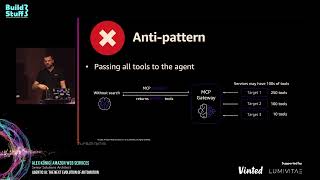 40mAgentic AI: The Next Evolution of Automation
 01h 01mKeynote Panel: Future of AI agents
 01h 28mAI Coding Agents and how to code them