Movement Matters: Effects of Motion and Mimicry on Perception of Similarity and Closeness in ...

summary
A lab experiment uses a telepresence robot with three conditions 3 conditions — static, mimicry of the participant’s body orientation, and random replay of another participant’s movements — during a 5-minute task and finds that any robot movement raises perceived similarity (homophily) compared to static but does not increase closeness overall. Mimicry and random movement produce similar effects, effects amplify for high self-monitors, men report greater closeness with movement while women report greater closeness when the robot is static, and the robot’s behavior is limited to orientation-only movement.
AI-written summary · about
chapters (13)
- 0:00Introduction
- 0:22What is telepresence robot
- 0:43Telepresence robot enriched remote communication
- 1:07What is rapport
- 2:03Does movement matter
- 3:55Self monitoring
- 4:54Gender difference
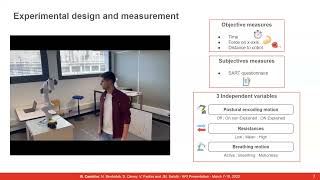
- 5:23Experiment
- 8:01Demonstration
- 8:36Results
- 12:56Conclusions
- 14:07Limitations
- 15:13Questions
related talks
 09mTask-Consistent Signaling Motions for Improved Understanding in Human-Robot Interaction and ...
 08mYou're delaying my task?! Impact of Task Order and Motive on Perceptions of a Robot
 13mReality Promises: Virtual-Physical Decoupling Illusions in Mixed Reality via Invisible Mobile Robots
 09mWhy do We Follow Robots? An Experimental Investigation of Conformity with Robot, Human, and ...
 10mExploring Machine-like Behaviors for a Socially Acceptable Robot Navigation in Elevators
 17mNo Place I’d Rather Be: The Future of Telepresence
 10mSharing the Spotlight: Co-presenting with a Humanoid Robot
 28mPreference Learning from Minimal Human Feedback for Interactive