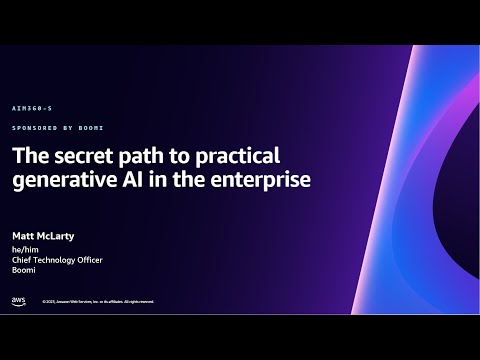
The secret path to practical generative AI in the enterprise
summary
Argues that enterprise GenAI succeeds only with two engineered pipelines: a context pipeline that extracts, transforms and embeds enterprise data and an action pipeline that injects model outputs back into applications. Demonstrates a no‑code Boomi implementation called BRAG that uses OpenAI for embeddings and Pinecone for vectors, then swaps to AWS Bedrock/Claude and Kendra to prove portability. Claims orchestration, session persistence and governance are required and shows the BRAG workflow runs and adapts across providers.
AI-written summary · about
chapters (9)
- 0:00Introduction to generative AI
- 2:50Digital transformation meets GenAI
- 5:21Systems of record and intelligence
- 7:11Context and action pipelines
- 10:40Keeping options open with pipelines
- 13:29Boomi's foundational role
- 14:56Emerging patterns in GenAI
- 16:00RAG and Boomi's BRAG
- 18:48Reusable digital transformation work
related talks
 22mLearning to Apply Generative AI at Enterprise Level
 33mSimplifying Generative AI App Development Why Standards Matter
 24mScalable GenAI in Production
 29mGenerative AI: Path to Value in practice
 33mCompose GenAI Apps: May the Force Be with Your Data and Models
 27mGenerative AI for technology leaders
 48mSpring AI: Integrating Generative AI in Java Enterprise
 34mHow will GenAI impact enterprise data and AI strategy?