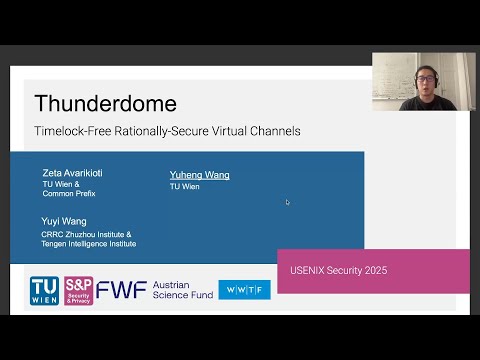
Thunderdome: Timelock-Free Rationally-Secure Virtual Channels
summary
Proposes a timelock-free payment channels construction that builds virtual channels on top of two underlying channels and a committee of bonded wardens (watchtowers) committee that publish states when a counterparty is offline; opening requires committee signatures and closing happens either collaboratively or pessimistically by wardens publishing the highest-sequence state with a 2f+1 threshold to avoid fund loss. Provides a Byzantine security proof assuming honest-majority wardens, a formal game-theoretic proof of rational security, and an Ethereum prototype with costs about $15 open / $7 worst-case close.
AI-written summary · about
chapters (13)
- 0:00Introduction
- 1:15Blockchain scalability and Layer 2
- 3:19Payment channels fundamentals
- 4:25Virtual channels and time locks
- 5:29Thunderdome overview
- 6:32Opening Thunderdome channel
- 7:14Updating states in Thunderdome
- 7:55Collaborative closing
- 8:57Pessimistic closing with wardens
- 10:01Security analysis
- 11:48Implementation and gas costs
- 12:51Future research
- 13:56Key takeaways and conclusion
related talks
 50mLIVE w/ Andrew Poelstra & Brandon Goodell
 58mBlockchains and Publicly-Verifiable Lotteries
 18mMEV Minimization on L2: Solution Space and Design Constraints
 45mMEVconomic Panel: MEVconomic Security in Liquid and Restaking Protocols
 28mPaying for Privacy Preserving Messaging
 01h 12mScaling distributed ledgers: Achieving arbitrary throughput and sub-second latency
 27mThe Need for a Layer-two Network in Monero
 28mBlink – Scalability with Sub-second Latency