Sharing without Scaring: Enabling Smartphones to Become Aware of Temporary Sharing

summary
A prototype Android service called DSA detects handover gestures from motion sensors and uses behavioral-biometric in-place authentication to verify the owner when the device returns, then enforces app-level access control and notification hiding. Evaluation uses ~3,700 labeled clips (n=18) for handover detection and 50 sharing sessions (n=10); cross-user models reach ~98% precision, ~95% recall, median detection time ~2.33 s, and DSA automatically handles 41 sessions while correcting seven more.
AI-written summary · about
chapters (9)
- 0:00Intro
- 1:18Device Sharing Protection Solutions
- 1:59Owner's Failure to Enable Sharing Protection
- 2:47Device Sharing Awareness (DSA)
- 3:58Sharing Gesture Detection
- 5:07Owner Detection
- 6:05Implementation
- 6:45Evaluation Setup
- 7:32Handover Detection Results
related talks
 20mChameleon Devices: Investigating More Secure and Discreet Mobile Interactions via Active ...
 06mTowards Usable and Secure Location-based Smartphone Authentication
 19mThumprint: Socially-Inclusive Local Group Authentication Through Shared Secret Knocks
 06mTouchID: User Authentication on Mobile Devices via Inertial-Touch Gesture Analysis
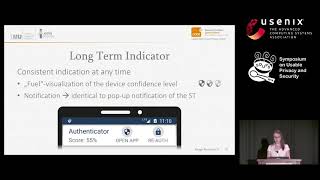 22mCommunicating Device Confidence Level and Upcoming Re-Authentications in Continuous
 19mBetter the Devil You Know: Exposing the Data Sharing Practices of Smartphone Apps
 29mSmartAuth: User-Centered Authorization for the Internet of Things
 28mBinding tokens