AI in Healthcare
summary
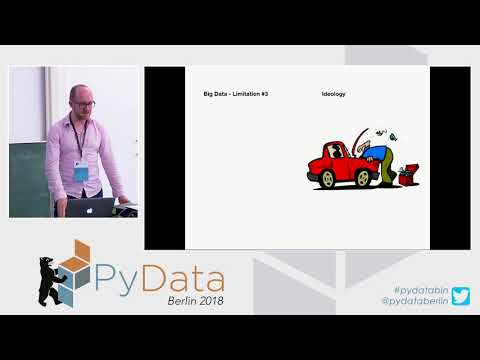
Claims that convolutional neural networks match clinicians on chest radiographs and in one report beat 15 doctors on tumour diagnosis while running 2–3× faster and that pure ML finds patterns in high-D data. Counterclaims note biology often has N of three–thirteen per experiment, spurious correlations, poor out-of-distribution generalization, and no mechanism. A hybrid system in Berlin augments MRI with a physics simulation to make voxel-level save/no-save predictions for a drug that carries 15% mortality risk within a four-hour window.
AI-written summary · about
chapters (17)
- 0:00Introduction
- 1:50AI in medical decisions
- 3:55ML approaches in healthcare
- 6:05Big data limits in biology
- 10:35Statistical limits & spurious correlations
- 11:39Model-free approach limits
- 13:23Medical AI generalization
- 15:51Need mechanistic insights
- 17:37Modeling in biology
- 21:50Scaling modeling challenges
- 23:12Hybrid AI-simulation models
- 28:06Projects & future directions
- 29:10Q&A: Stroke prediction
- 30:14Q&A: Neural network trust
- 32:48Q&A: Tree models & data
- 34:18Q&A: Clinicians' views
- 35:30Q&A: Big data & prior knowledge
related talks
 37mAI in medicine: where do we stand?
 09mHow AI is changing the healthcare system
 44mAI in the Clinic: Prediction is Better Than Cure
 23mAI in the Life Science Sector
 28mMachine Learning & Healthcare
 47mAI for making decisions in clinical medicine
 18mCan AI make us smarter than cancer
 29mHow AI Is Transforming Medical Imaging