Five things I learned from turning research papers into industry prototypes
summary
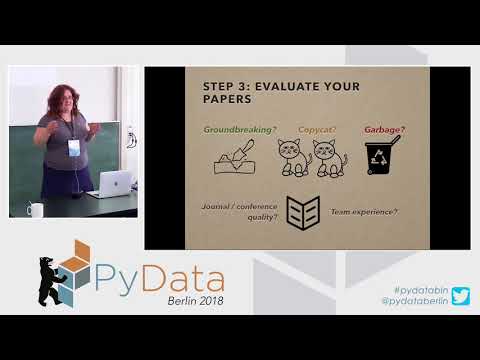
A practical five-step workflow converts papers into working prototypes: five-step workflow, search and evaluate by concrete metrics and baselines, prioritize by expected impact versus effort, then prototype in a high-level language. Reproducibility is the main hurdle—about reproducibility failure ~80% of attempts fail to match reported results—so match datasets and preprocessing exactly (the example uses roughly 20k page images) and implement under same conditions before adapting. Track experiments in a spreadsheet and email authors for missing hyperparameters.
AI-written summary · about
chapters (19)
- 0:00Introduction
- 1:31Challenges in implementing papers
- 3:19Five-step prototyping process
- 4:25Step 1: Finding relevant research
- 6:39Step 2: Defining comparison criteria
- 8:03Step 3: Evaluating papers
- 10:12Key sections in papers
- 13:50Reproducibility and reliability
- 17:43Prioritizing papers
- 19:12Step 5: Building prototypes
- 20:58Prototyping recommendations
- 23:05When to implement papers
- 24:34Q&A: Missing hyperparameters
- 25:38Q&A: Time allocation
- 26:21Q&A: Easing implementation
- 27:05Q&A: Finding paper reviews
- 27:48Q&A: Evaluating papers
- 28:30Q&A: Reproducibility challenges
- 28:53Q&A: Time and outcome
related talks
 45mHow to Fail Interpretability Research
 05mA glimpse into a Data Scientist’s work - implementing algorithms from research papers
 01mintro video
 15mResearch to Reality: Bringing Frontier ML Research to Production
 22mHow to operationalize AI
 29m5 Things You Want to Know About AI Adoption in the Enterprise
 40mDesigning Data Driven Projects: Beyond ML Experimentation
 44mHit the (ML) Road(map) Jack