AI in medicine: where do we stand?

summary
Presents concrete medical AI results and limits: tabular models (XGBoost with SHAP) predict 10‑year prostate cancer mortality from an NCI cohort (~80k patients, ~8k cancer cases) with an online inference demo; imaging work includes CheXNet on ~100k chest X‑rays, dermoscopy CNNs that outperform 21 dermatologists, and ResNet50 on ~700k satellite tiles to map cancer prevalence. Also reports LLM performance—models passing USMLE at ~85% and GPT‑4 diagnosing at ~87% versus 65% for physicians—and discusses risks like data bias, adversarial attacks, and limited clinical validation.
AI-written summary · about
chapters (15)
- 0:00Introduction
- 2:11AI in medicine: definitions
- 3:55History of medical AI
- 5:41Medical data & AI frameworks
- 7:47Medical AI challenges
- 8:51Prostate cancer risk prediction
- 12:00Disease prediction from records
- 13:03Medical imaging AI: detection
- 16:10Non-radiological image AI
- 19:21Depression diagnosis via social media
- 20:03Cancer prevalence from satellite imaging
- 21:28Generative models & LLMs in medicine
- 24:36Risks & limits of medical AI
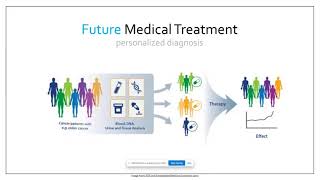
- 27:45Future of AI in healthcare
- 29:52Q&A
related talks
 47mAI for making decisions in clinical medicine
 36mAI in Healthcare
 23mAI in the Life Science Sector
 36mResponsible AI
 28mThe Future of Healthcare – AI’s Promise and the Challenges Ahead
 09mHow AI is changing the healthcare system
 18mCan AI make us smarter than cancer
 44mAI in the Clinic: Prediction is Better Than Cure