Finding Lane Lines for Self Driving Cars
summary
A concrete pipeline uses Python and OpenCV to undistort, warp to bird’s-eye view, apply Gaussian blur, color thresholds, Canny and Sobel edge detection, Hough/probabilistic fitting and numpy polyfit to produce lane curves and a filled drivable polygon over dashcam video. It works reliably on highway footage from the Udacity dataset, runs slowly in this demo (20s video -> 3.5 minutes), degrades with occlusions or tight corners, and falls back to method two uses prior fit for speed and robustness.
AI-written summary · about
chapters (20)
- 0:00Self-driving lane detection intro
- 1:11Autonomous vehicle core tasks
- 4:06Lane line detection process
- 5:09Removing camera distortion
- 7:57Bird's eye view warping
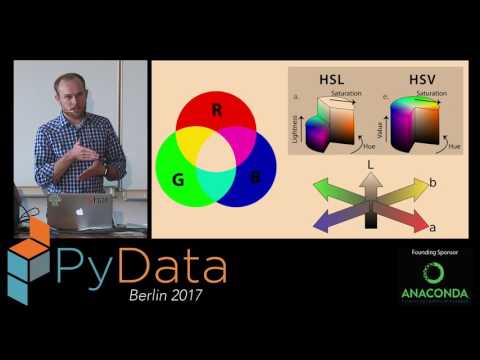
- 9:03Color selection for lanes
- 10:53Color spaces for detection
- 14:06Edge detection methods
- 15:30Binary thresholding
- 18:03Fitting curves to lanes
- 21:57Lane curvature and position
- 23:21Overlaying results on video
- 24:49Real-world challenges
- 27:21Testing and validation
- 29:30Urban road limitations
- 31:41Automating testing and data
- 32:263D modeling vs projections
- 33:55Deep learning future
- 35:20Temporal smoothing
- 36:58Handling shadows and fusion
related talks
 22mHow to effectively extract image features – let’s play with...
 05mInterview
 46mML Use Cases at Think Big Analytics
 31mDeep learning for self-driving vehicle technology
 28mEstimating Traffic Flow to find New Drive Thru Locations
 24mBeyond the Frame: Using Computer Vision to Unlock the Potential of Video Data
 17mDigital Eyes on the Road: Using Street Cameras to Verify Traffic Integrity and...
 19mAI Trends in Intelligent Transport Systems