Semi-Supervised Bootstrapping of Relationship Extractors
summary
Claims that replacing TF‑IDF with distributional word embeddings improves semi‑supervised bootstrapping for relationship extraction, extracting more correct instances (especially affiliation) on a 1.2M‑sentence Gigaword news corpus. Pipeline uses NER + POS filters (Reverb patterns), sums non‑stopword word vectors (200‑dim) to make context vectors, clusters seed contexts, and scores patterns with a max‑instance similarity instead of averaging. Results show word embeddings outperform TF‑IDF though POS‑only cues and ranking heuristics cause errors and long runtimes.
AI-written summary · about
chapters (20)
- 0:00Semantic relationship extraction
- 2:31Relationship extraction methods
- 4:17Rule-based and supervised approaches
- 5:41Bootstrapping fundamentals
- 7:46History of bootstrapping
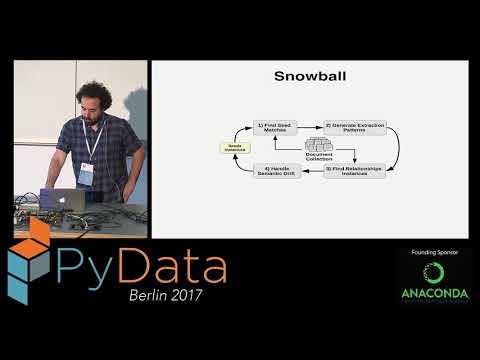
- 9:11Snowball system deep dive
- 13:30Snowball with word embeddings
- 17:11Extraction patterns with embeddings
- 19:44Semantic drift handling
- 22:55System workflow and iterations
- 23:38Experimental setup
- 25:47Evaluation results
- 27:33Limitations and improvements
- 30:07Q&A: context weighting
- 31:21Bottlenecks and scalability
- 33:10Q&A: temporal relationships
- 35:16Q&A: same-name entities
- 36:00Q&A: similarity metrics
- 37:49Q&A: embedding similarity
- 38:09Closing remarks
related talks
 34mWord Embeddings for fun and profit in Gensim
 26mDeep Learning Architectures for Semantic Relation Detection Tasks
 01h 03mWord Embedding For Fun and Profit
 01h 01mWord Embeddings - An Alternative & Efficient Approach to Search for Docs
 30m(Re)training word embeddings for a specific domain
 38mUnderstanding and Applying Self-Attention for NLP
 43mDemocratizing NLP content modeling with transfer learning using GPUs
 45mHybrid search: Greater than the sum of its parts?