"Evidence-Guided Product Development"
summary
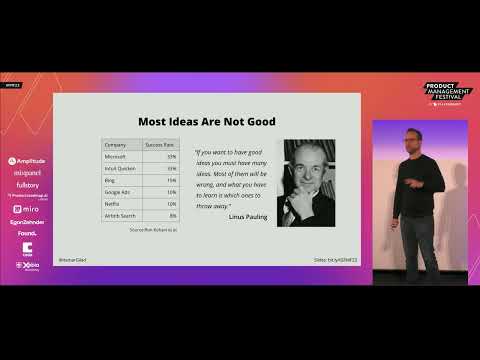
Claims a framework called GIST (goals, ideas, steps, tasks) and a practical confidence meter to turn opinions into measurable evidence, arguing roughly half of new features fail and many teams see 40–50% waste. Shows ICE scoring and a CRM chatbot example: initial ICE feels like high impact/low ease but confidence ~0.8, a 12‑person Wizard of Oz usability test lowers expected impact and raises confidence to ~2.8, then a 200‑customer two‑week longitudinal alpha pushes impact to 5 and confidence to ~5.8, which justifies full launch.
AI-written summary · about
chapters (13)
- 0:00Introduction and giveaway
- 0:51The flaws of rigid planning
- 2:29Why traditional planning fails
- 3:53Introducing evidence-guided
- 5:45The gist framework
- 6:58Idea evaluation and waste
- 9:01The product discovery process
- 10:52Chatbot example and ICE
- 13:49The confidence meter
- 18:35Validating ideas with tests
- 21:07Longitudinal studies
- 22:44New approach to planning
- 24:51Impact on organizational culture
related talks
 01mThe Art and Science of Building Quality Products
 13mCommitting to quality
 36mHow Good Is Your Software Product? (Evolving "Quality"Throughout The SDLC)
 50mSo you think a new tool will help? Here’s an idea-t to think about…
 35mSmarter Testing Through Smarter Testers
 46mEnhancing Agent Reliability Through Evaluation-Driven Development
 42mYou don’t know what you know until you find out – Guide for doing QA Assessments
 25mHeuristics to help you design, build, and choose test tools