Perceived realism of pedestrian crowds trajectories in VR

summary
Study compares real-world traces (280 pedestrians) to cheap, collision-free rectilinear constant-speed trajectories rendered with motion-captured locomotion and initialized by real entry/exit times and Monte Carlo sampled speeds. Remote study (153 participants) and a VR test on Oculus Quest measure perceived realism and immersion. Results show no statistical difference between real and synthetic trajectories and no immersion loss, so low-cost trajectory generation reproduces realism for high-density crosswalk scenes.
AI-written summary · about
related talks
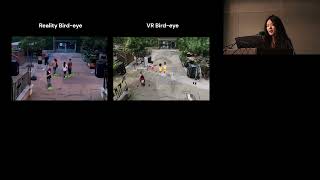 12mDo You See What I See? Bring Live Pedestrians into an Outdoor Collaborative Mixed Reality Experience
 18mDreamWalker: Substituting Real-World Walking Experiences with a Virtual Reality
 09mVR-STEP: Walking-in-Place using Inertial Sensing for Hands Free Navigation in Mobile VR Environments
 15mOutstanding: A Multi-Perspective Travel Approach for Virtual Reality Games
 46mScience based Design Decision Making for Virtual Reality
 43mThe Real, the Virtual, and the Cortex
 08mA Matter of Perspective: Designing Immersive Character Transitions for Virtual Reality Games
 45mLocomotion: Going places in VR