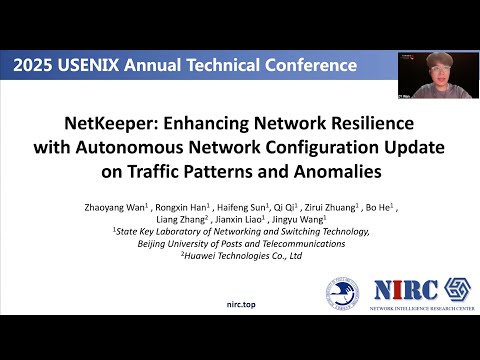
NetKeeper: Enhancing Network Resilience with Autonomous Network Configuration...
summary
NetKeeper implements northbound and southbound interfaces plus a DSL and interpreter that accept natural language and anomaly logs parsed by a fine‑tuned phantom 6B model, then applies a decentralized actor‑critic multi-agent RL system with GCN and transformer encoders to adjust BGP/OSPF and link parameters. Evaluation reports 99.6% policy consistency, average configuration update time of 4.07s, 5.3% throughput improvement, 8.7% less traffic shift, and an enterprise deployment with 94.8% config accuracy, 39.4% resilience gain and 51.5% fewer manual interventions.
AI-written summary · about
chapters (13)
- 0:00NetKeeper overview
- 1:01Network config challenges
- 2:04Autonomous resilience areas
- 3:06NetKeeper architecture
- 5:20Intent translation and validation
- 7:12Config update objectives
- 8:13Multi-agent RL approach
- 9:43Agent functions
- 12:09Experimental setup
- 13:12Performance results
- 15:48Dynamic event handling
- 16:53Real-world deployment
- 17:16Summary and future
related talks
 24mAutomatically Correcting Networks with NEAt
 18mAPKeep: Realtime Verification for Real Networks
 19mNetEdit: Fine-grained Network Tuning at Scale
 23mNetBouncer: Active Device and Link Failure Localization in Data Center Networks
 26mSIG Network Intro and Updates
 30mUsing Python to design, configure, and measure large-scale networks
 20mNetKernel: Making Network Stack Part of the Virtualized Infrastructure
 16mConfig-Snob: Tuning for the Best Configurations of Networking Protocol Stack