Dealing with Data Pack Rats: Reduce Data Footprints to Control Risks
summary
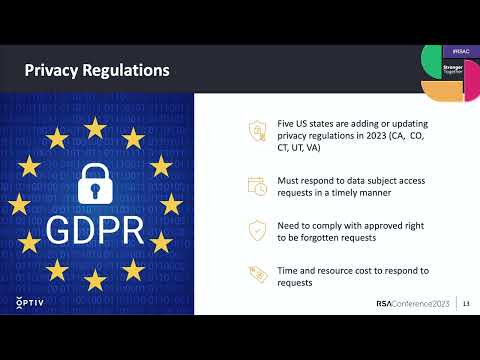
Argues that hoarding raises legal, operational and cyber risk and offers concrete tactics: classify data elements (examples up to 400 elements), build a disposition policy tied to PCI HIPAA SOX retention rules, consolidate systems, and use data discovery and DLP tools plus fingerprinting to find leaks. Warns that data lakes lock records in place — one case has 50 petabytes and 5–7,000 GDPR requests costing an estimated $10M to remediate — and recommends tokenization, column/app encryption, anonymization, and multi‑pass destruction.
AI-written summary · about
chapters (15)
- 0:00Introduction to data hoarding
- 1:04Learning objectives overview
- 2:08Understanding data footprints
- 6:21Regulatory retention requirements
- 8:49Business drivers for data retention
- 12:21Risks of excessive data retention
- 15:11Legal risks and subpoenas
- 18:21Operational costs of data storage
- 20:15Data lakes and privacy challenges
- 22:37Developing a data disposition plan
- 26:48Reducing data footprints
- 33:05Encryption and data protection
- 35:53Destroying data securely
- 36:40Next steps and action plan
- 39:27Q&A session
related talks
 24mStop Making Your Data Team the 'Data Police'
 31mDemystifying Data Protection: Steps To Find, Monitor And Control Without Chaos
 20mWhy data privacy is critical for robust data management?
 40mData Privacy and Security by Design
 01h 59mDeep Dive Workshop – Data Security and Data Protection
 49mSecure Modern Data Lakes - A Primer
 01h 00mManaging Privacy and Cyber In A Pandemic: Lessons Learned For 2021 & Beyond
 40mA Data Protection Problem: Insider Risk