Graphic Testing Without Hardware: Discovering the Power of VKMS!

summary
VKMS is a Linux kernel DRM driver that emulates a full display pipeline (planes → CRTC → encoder → connector) so compositors and DRM-using apps run in VMs or laptops without boards. Features implemented include VKMS DRM kernel driver, plane composition with a rightback readback buffer for pixel verification, format control (restrict to RGB888 or add 10/12-bit HDR), and a configfs device creation interface to make dynamic CRTCs/encoders/planes/connectors. Current limits: default series supports up to 8 overlays, per-device memory for framebuffers can exhaust RAM and DRM caps connectors/CRTCs at 31. Patched series and branches live on the mailing list/GitHub for testing.
AI-written summary · about
chapters (16)
- 0:00Graphic testing without hardware
- 1:30Hardware emulation for display testing
- 4:23What is VKMS and how it works
- 6:13Display pipeline VKMS emulates
- 8:20Upstream capabilities of VKMS
- 13:06Configuring VKMS with null args
- 16:39ConfigFS interface for VKMS
- 18:07Live demo with ConfigFS
- 24:25Configuring CRTCs and encoders
- 27:19Testing output with modetest
- 28:34Dynamic connector management
- 31:06Planned VKMS enhancements
- 32:08Live demo advanced config
- 35:27Limiting color formats
- 38:19Dynamic connectors and HDR
- 41:38Summary and Q&A
related talks
 44mA Current Overview of the DRM KMS Driver-Side APIs
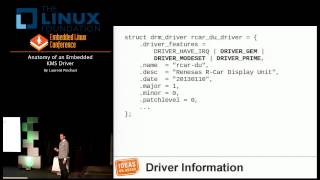 51mAnatomy of an Embedded KMS Driver
 44mGraphics: A Frame's Journey
 39mNavigating the Linux Graphics Stack
 41mWalking Through the Linux-Based Graphics Stack
 39mOverview of a Modern DRM Driver
- 39mOverview of a Modern DRM Driver
 52mGetting pixels on screen on Linux: introduction to Kernel Mode Setting