Engineering Trust: Formulating Continuous Compliance for Open Sour...

summary
Eclipse Trustable Software Framework (TSF) provides a git‑based, workflow‑agnostic model that records objectives as linked statements, hashes artifacts for change detection, runs validator plugins (Python) inside CI (examples use GitLab CI) and emits human‑scored reports producing an automated, traceable body of evidence with a quantified confidence score. It targets continuous compliance, maps evidence to standards like IEC 61508 and ISO 26262, and keeps a git‑only dependency for provenance. Validator plugins and GitLab CI integration enable live impact analysis.
AI-written summary · about
chapters (18)
- 0:00Trustable Software Framework intro
- 1:06TSF origins and goals
- 2:08Software complexity challenges
- 4:57Paper-driven compliance problems
- 9:11TSF design principles
- 10:36Breaking down TSF model
- 14:49TSF vs traditional V-model
- 18:18Objectives and claims to evidence
- 21:48Metadata and artifacts in Git
- 23:53Evidence types in compliance
- 25:38Evidence integration with CI
- 28:49Reports and progress tracking
- 29:31Continuous compliance with TSF
- 31:16Q&A on documentation and open-source challenges
- 33:45Safety assessor needs
- 35:10Compliance standards collaboration
- 37:57Q&A on standards to evidence
- 40:06Final thoughts
related talks
 25mBad Behaviour: Automating System-level Safety Testing Using Open Source Tools
 01h 21mOpen Source Best Practices at Eclipse Foundation
 33mAI-Powered Open Source Risk Management: ISO Self-Certification Kit and 5-Level AI Coding Guide
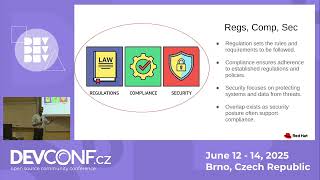 45mRegulated and Sovereign : Impact to the Open Source Developer
 30mFast, Lean, Precise, Controlled: Compliance Automation With OSCAL in Our Open-S...
 47mBuilding Trust in Open Source: A Practical Guide to Securing Your ...
 40mBuilding Developer Confidence in Software Security with the DevRel Community
 18mExploration of Compliance Governance Based on Operating Systems