Understanding the impact of host networking elements on traffic bursts

summary
Valinor combines eBPF hooks inside the host and a programmable data‑plane collector to timestamp packets from nanoseconds to seconds and attribute bursts to specific layers. Measurements show TCP pacing is often neutralized by segmentation offload and multi‑queue NICs, driver ring sizing and Linux’s byte_q_limits create heavier bursts, and process scheduling can push Hurst from ~0.5 to ~0.7 under CPU contention. Empirical Hurst examples: Cubic ≈0.6, DCTCP ≈0.5, BBR ≈0.4.
AI-written summary · about
chapters (8)
- 0:00Intro
- 1:08Burstiness degrades performance
- 1:54Buffer sizing depends on burst scales
- 5:27Valinor: A network traffic burst analyzer
- 9:24Observing TCP congestion control variants
- 10:50Is software effective in shaping the traffic?
- 12:33Even process scheduling matters!
- 14:31Implications for network design
related talks
 23mACK to the Future: TCP in 2025
 36mThe black art of network performances
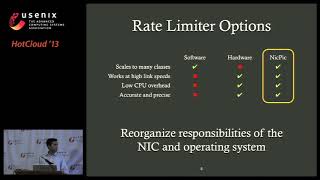 30mNicPic: Scalable and Accurate End-Host Rate Limiting
 07mLightning Talk: Taming Noisy Network Neigbours with Cilium and eBPF
 30mThe Gashlycrumb Tinies of AI Networking You Must Know (or Languish!)
 22mLIVE Q&A #3
 21mQ&A Session 1 – Neil Spring
 31mTuning Linux TCP for data-center networks