Bolt: Sub-RTT Congestion Control for Ultra-Low Latency

summary
Bolt pushes congestion control to sub-RTT reaction by using programmable switches to emit immediate per‑packet feedback and by combining Sub-RTT Control (SRC) with Proactive Ramp-Up (PRU) and Supply matching (SM). Implemented on SNAP in a Google testbed and evaluated up to 400 Gbps, it cuts 99th‑percentile latency by ~80% and improves 99th‑percentile flow completion times up to 3× versus Swift and HPCC while SRC packet overhead stays below 0.35% of bottleneck capacity.
AI-written summary · about
chapters (6)
- 0:00Introduction and motivation
- 2:46Defining the optimal approach
- 4:29Mechanism for sub-RTT control
- 7:22Addressing underutilization
- 9:36Experimental results
- 12:22Performance and conclusions
related talks
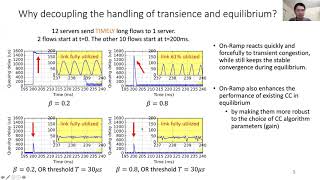 12mBreaking the Transience-Equilibrium Nexus: A New Approach to Datacenter Packet Transport
 16mR-TCP: A Framework to Optimize TCP Performance Over Rate-Limiting Networks
 17mBarre: Empowering Simplified and Versatile Programmable Congestion Control in...
 19mSwCC: Software-Programmable and Per-Packet Congestion Control in RDMA Engine
 19mTackling DC Congestion and Bursts
 18mRevisiting Congestion Control for Lossless Ethernet
 23mACK to the Future: TCP in 2025
 31mRapid Start: Faster Internet Connections, with Ruby's Help