Breaking the Transience-Equilibrium Nexus: A New Approach to Datacenter Packet Transport

summary
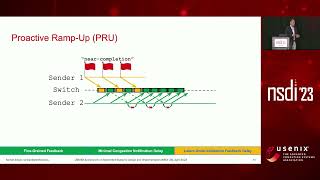
Presents On-Ramp, an underlay algorithm that intercepts and temporarily holds packets at the datacenter edge to handle transient overloads while leaving existing congestion-control protocols (CUBIC, BBR, DCQCN, TIMELY, DCTCP, HPCC) to manage equilibrium. On-Ramp detects transients using software one-way delay measurements enabled by a time‑synchronization algorithm and is evaluated on Google Cloud, CloudLab, and ns-3, showing large reductions in 99th‑percentile request completion times and improved flow completion for background traffic.
AI-written summary · about
chapters (5)
- 0:00Start
- 0:39Evolution of Data Center Congestion Control (CC) Algorithms & Transport Protocols
- 2:16Why decoupling the handling of transience and equilibrium?
- 8:56Evaluation Highlights (more in the paper)
- 9:48Evaluation in Facebook: Highlights Imore in the paper
related talks
 16mBolt: Sub-RTT Congestion Control for Ultra-Low Latency
 19mTackling DC Congestion and Bursts
 22mAdapting TCP for Reconfigurable Datacenter Networks
 18mMeasuring Congestion in High Performance Datacenter Interconnects
 18mCCC: Re-architecting Delay-based Congestion Control in Datacenter Networks
 05mJump-starting back-office connections
 18mRevisiting Congestion Control for Lossless Ethernet
 14mRDC: Energy-Efficient Data Center Network Congestion Relief with Topological