Building Flexible, Low-Cost Wireless Access Networks With Magma
summary
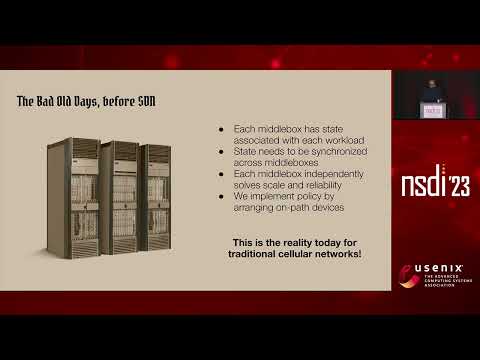
Magma refactors the cellular core by terminating RAN protocols at the edge and using a cloud orchestrator plus one access gateway per cell site to push user datapaths to the internet, configured via SDN-like control. Evaluation uses Spirent Landslide emulation, OVS dataplane, and a bare-metal $370 board; a single gateway handles ~100 active users and ~150 Mbps. Deployments report reduced per-site costs by 43% and a 5,000+ access gateways deployed rollout supporting 8,000 radios across 49 states, while noting limits on attach rates and lack of wide-area mobility.
AI-written summary · about
chapters (10)
- 0:00Introduction and context
- 0:57The case for a new approach
- 2:42Inspiration from the field
- 5:32Architectural design goals
- 8:30The Magma architecture
- 10:48Managing distributed state
- 12:20Implications and benefits
- 13:53Evaluation and performance
- 15:54Production deployments
- 18:03Challenges and conclusion
related talks
 36mPanel: Magma End Users
 34mMagma User story: WiConnect
 24mMagma a Cloud Native Converged Core, Use Cases and Architecture
 46mBuild an inexpensive carrier-WiFi network on your laptop with Magma
 13mOpening Keynote
 18mMagma 101: An introduction to Magma
 22mMagmaML: Towards Automated Management for Low-resource 5G Cellular Network Deployments
 24mSpectrum Innovation Building Blocks