The Power of Composition
summary
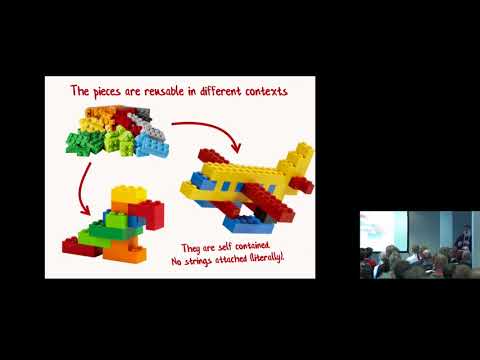
Clear claim: build large systems by composing tiny functions and types. Uses F# code: composition operator and pipe and compose operators, currying and partial application to turn multi-arg methods into composable one-arg functions, map/iterate for lists, and bind/monads to chain effectful steps. Shows a composable Roman‑numeral replacer and a carbonation FizzBuzz pipeline, then assembles reusable web parts into an object-free web application using Suave — a working demo that keeps IO at the edges and scales by composition.
AI-written summary · about
chapters (12)
- 0:00Start
- 1:37The Power Of Composition
- 3:03How to learn functional programming
- 4:34Prerequisites for understanding composition
- 7:35Wooden Railway Track Philosophy
- 9:02Unix Philosophy
- 10:30Core principles of FP
- 31:18To Roman Numerals
- 37:20Inline Partial Application
- 40:01A simple implementation
- 41:04Pipeline implementation
- 57:37A complete web app
related talks
 30mCompose All the Things
 59mThe Power of Function Composition
 26mThe Power Of Small Abstractions
 28mOh Composable World!
 57mPipeline-oriented programming
 59mBuilding an Intuition for Composition
 28mCompose at Scale: Stop Unnecessary Recomposition
 32mScalable Front End Architecture with the Composition API and Composable Functions