Can OVS-DPDK be further optimised?

summary
Asks whether OVS-DPDK needs new assumptions rather than tweaks and shows concrete tools and metrics: a pvp test script that runs looped traffic, a Python syscall analyzer that captures PMD thread syscalls and collapses callbacks (one run shows ~56k callback events), and work-in-progress partial hardware offload for flow markers. Explains datapath behavior (32-packet bursts, ~8k exact-match cache, SMC layer, slowpath to userspace), points at RCU wakeups and syscalls as hot spots and recommends sharing measured deployment profiles.
AI-written summary · about
chapters (9)
- 0:00Intro
- 0:30What is Open vSwitch OVS1
- 1:05OVS DPDK specific performance
- 2:18What influences forwarding performance
- 5:22What can we do (as developers)
- 8:34Will these changes improve performance?
- 12:02Reference architectures
- 13:45What do we need?
- 15:31What's next..
related talks
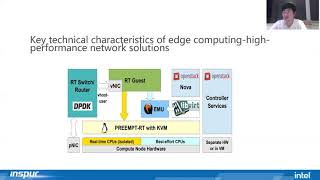 25mDPDK performance optimization for edge computing scenario
 28mDPDK vs ODP: A comparison
 18mOpen vSwitch with AF_XDP as a userspace datapath
 14mPerf Characteristics of Userspace & Kernel-Space Datapaths in Container Networking
 02h 53mPreview Sessions
 35mWhy OCP networking performances on VMs are suboptimal and how to improve them by 5x
 36mRunning High-performance User-space Packet Processing Apps in Kubernetes
 36mBringing vDPA to Life in Kubernetes