Perf Characteristics of Userspace & Kernel-Space Datapaths in Container Networking

summary
Proof-of-concept VDUSE OVS-DPDK userspace datapath is implemented for OpenShift using OVS-DPDK, a VDUSE kernel driver (control via a character device) and shared-memory data paths, with CPU isolation and DPDK tuning used for benchmarks. Results show VDUSE OVS-DPDK userspace datapath delivers on-par or faster for small/medium packets, achieves higher TX/RX PPS, and reports smaller latency stddev, but lags on large packets where kernel veth+OVS scaling still wins.
AI-written summary · about
chapters (9)
- 0:00Userspace datapaths intro
- 1:08ViDPA background and goals
- 3:42Hardware ViDPA evolution
- 7:43ViDPA and OVS-DPDK in OpenShift
- 9:35Benchmarking setup
- 10:40TCP throughput results
- 11:45TCP latency comparison
- 12:26TXPS and RX PPS findings
- 13:31ViDPA status and future
related talks
 20mCan OVS-DPDK be further optimised?
 18mOpen vSwitch with AF_XDP as a userspace datapath
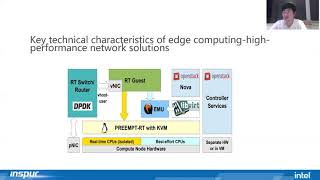 25mDPDK performance optimization for edge computing scenario
 51mAccelerate containers and VMs networking with vDPA
 36mBringing vDPA to Life in Kubernetes
 37mSPDK Based User Space NVMe Over TCP Transport Solution
 36mRunning High-performance User-space Packet Processing Apps in Kubernetes
 28mDPDK vs ODP: A comparison