Playing Offense and Defense with Deepfakes

summary
Step‑by‑step deepfake internals: face extraction with MT‑CNN, autoencoder training in Keras (original FaceSwap/face‑flop architecture), and conversion that decodes person B into person A’s frames. A 300‑video collection is used for experiments and an automated kit called DeepStar assembles downloads, trains models, merges mouth swaps and can mass‑deliver links. A mouth‑focused detector MouthNet reports ~83% validation accuracy, catches 41% of held‑out fakes at a 0.9 threshold (53% at 0.5 with 26% false positives). Several political mouth‑swap demos are built but not distributed.
AI-written summary · about
chapters (10)
- 0:00Start
- 35:02Recurrent Neural Networks Image Classifier +LSTM
- 35:41Head Poses
- 36:33Deepfake Artifacts
- 38:07Generalized Detection Method Results
- 38:57Individualized Detection Methods
- 40:35Open Detection Method Issues
- 43:43Intuition
- 47:31Video Misclassifications
- 49:41Deepstar
related talks
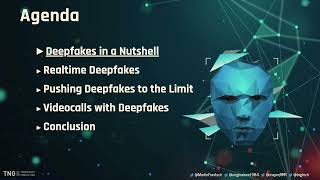 58mPushing Deepfakes to the Limit-Fake video calls with AI
 51mFaceswap: Developing a platform for practical Deepfakes
 01h 04mPushing Deepfakes to The Limit - Fake Video Calls With AI
 38mDIY Deep Fakes
 56mDeep Fakes 2.0 - How Neural Networks are Changing our World
 30mAI-Generated Synthetic Media, aka Deepfakes and its impact
 26mDeepfakes, audiofakes, and the future of media
 32mHeart to Heart and Eye to Eye with Deep Fakes