Pushing Deepfakes to The Limit - Fake Video Calls With AI

summary
A working pipeline for real-time whole-head replacement combines DeepFaceLab-style autoencoders with GAN refinement, TensorFlow 2 training, segmentation + inpainting and a MediaPipe face mesh alignment to remove earlier warping; training uses large celebrity datasets and claims 95%+ of generated deepfakes use DeepFaceLab. Live demos include a Zoom video-call experiment that convinces some targets but shows artifacts: warped facial geometry, smeared skin, inconsistent eyes; audio uses Tacotron 2-style TTS and is easier to detect in live translation, so video works today but remains imperfect.
AI-written summary · about
chapters (29)
- 0:00Introduction
- 0:11Technical difficulties
- 1:44Deep fake demonstration
- 3:51Deep fake threats
- 5:35Speaker introductions
- 6:46History of deep fakes
- 9:11Project goals
- 10:21How deep fakes work
- 13:44Real-time implementation
- 15:56Face segmentation
- 17:19Training data
- 19:41Inpainting techniques
- 21:05Autoencoder architecture
- 23:03GAN training explained
- 23:26GAN live roleplay
- 30:35Live demo
- 31:25Public reception
- 34:03Improving the fakes
- 34:33TensorFlow 2 transition
- 38:02Face mesh technology
- 39:28Face mesh demo
- 41:43Improved pipeline
- 44:06Security implications
- 47:20Scam simulation
- 49:05Detection methods
- 50:27Audio deep fakes
- 54:29Conclusion
- 57:56Q&A session
- 1:03:30Closing remarks
related talks
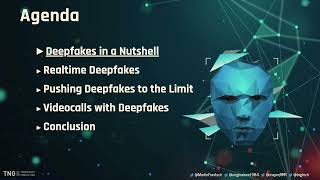 58mPushing Deepfakes to the Limit-Fake video calls with AI
 51mPlaying Offense and Defense with Deepfakes
 30mAI-Generated Synthetic Media, aka Deepfakes and its impact
 38mDIY Deep Fakes
 26mDeepfakes, audiofakes, and the future of media
 30mReality Under Attack: Just How Serious Is the Deep Fake Threat?
 16mThe Threat of Deepfakes to Remote Identity Verification Systems
 27mAl-Generated Attacks: The New Era of Threats to Authentication