WORM: Programming Collaborative Robots Through Manual Actions for Craft-Aligned Digital Fabrication

summary
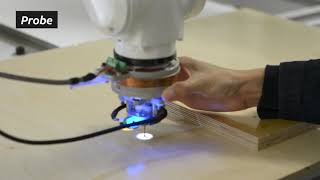
A system lets artists physically drive a cobot end effector like a handheld tool, record a low-level craft action (brushstroke, carving), then replay it as spatially parameterized repeats with previewed rotation angle and repetition count. The implementation uses a custom handle controller with trigger and joystick, supports seven repetition modes, and attaches tools like a hot wire cutter on foam to produce molds and textured cups. Evaluation includes a 3-hour study and a 4-hour expert evaluation with professional artists.
AI-written summary · about
chapters (16)
- 0:00Introduction to WORM
- 0:24Research background and motivation
- 1:28Why cobots suit craft fabrication
- 2:11Limitations of current cobot programming
- 2:56Introducing the WORM system
- 3:37Recording manual craft actions
- 4:19Defining spatial procedural repetitions
- 5:01Creating compound actions
- 5:22Custom handle controller design
- 6:07Demonstrative examples and artifacts
- 6:49User studies and design guidelines
- 8:54Benefits of manual input in fabrication
- 9:17Future directions and conclusion
- 9:39Q&A: Embodiment and creative practice
- 10:39Q&A: Degrees of freedom limitations
- 12:05Q&A: Surgical robots and future work
related talks
 09mSituated Live Programming for Human-Robot Collaboration
 07mAdroid: Augmenting Hands-on Making with a Collaborative Robot
 19mRoMA: Interactive Fabrication with Augmented Reality and a Robotic 3D Printer
 31mData as an instrument for more efficient collaboration with robots
 33mThe New Generation of Robots
 20mRobotic Assembly of Haptic Proxy Objects for Tangible Interaction and Virtual Reality
 40mRobots
 18mShapeBots: Shape-changing Swarm Robots