Unimanual Pen+Touch Input Using Variations of Precision Grip Postures

summary
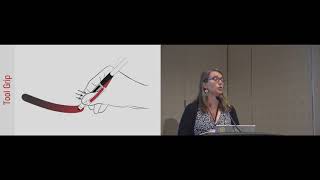
Introduces a pen+touch space using the writing hand to form distinct grip postures detected from raw capacitive images captured on a Wacom tablet; a formative study reduces 324 possibilities to 33 candidate postures, collects ~11,000 images per posture, and selects 10 for real-time use. A convolutional neural network trained on the data achieves 91% average accuracy and powers two working demos — a document annotator and a vector illustrator — validated by a small usability study that shows the approach is feasible.
AI-written summary · about
chapters (10)
- 0:00Introduction and motivation
- 1:10Posture design space explained
- 4:43First user study and results
- 7:35Recognizer training and accuracy
- 8:59Document annotation demo
- 11:55Design principles for postures
- 12:59Vector illustration demo
- 15:27Usability study findings
- 16:31Conclusion and acknowledgments
- 16:54Q&A session
related talks
 16mPentelligence: Combining Pen Tip Motion and Writing Sounds for Handwritten Digit Recognition
 21mSketchingWithHands: 3D Sketching Handheld Products with First-Person Hand Posture
 17mFlexStylus: Leveraging Bend Input for Pen Interaction
 06mDigiGlo: Exploring the Palm as an Input and Display Mechanism through Digital Gloves
 16mPortal-ble: Intuitive Free-hand Manipulation in Unbounded Smartphone-based Augmented Reality
 19mPulp Nonfiction: Low-Cost Touch Tracking for Paper
 28mStrike a Pose - Gesture recognition in JavaScript w/ ML & Arduino
 31mHybrid Body Craft