The Past and Future of Shiny

summary
Shiny celebrates its 10th anniversary since the July 31, 2012 demo and proves the Meteor trick works: a small reactive core powers HTML-like R UI elements, built as a proof of concept in seven weeks and productionized in R where R proves unusually suited. New work ships Shiny for Python (alpha) with examples like an AstroPy air‑mass calculator, deploys to shinyapps.io and RStudio Connect via rsconnect-python, and previews a visual editor plus testing via Shinytest2 on CRAN and a serverless Wasm path. reactive server logic Shiny for Python (alpha)
AI-written summary · about
chapters (22)
- 0:00Shiny’s origin story
- 1:50Shiny born in 2012
- 3:02Early influences and manipulate
- 5:57Why Shiny avoided traditional UI
- 8:46Meteor’s reactive magic
- 12:01Shiny’s architecture vision
- 13:31Life-changing decision to create Shiny
- 17:59Proof of concept in seven weeks
- 19:02Three critical questions for Shiny
- 20:28R users ready for web apps
- 22:55R community’s overwhelming response
- 28:17Why R for Shiny
- 35:51Shiny’s success and R’s advantages
- 36:33Shiny for Python intro
- 37:46Shiny for Python state and alpha
- 41:42Shiny for Python deployment
- 43:36Running Shiny for Python without a server
- 44:40Future: R and Python together
- 45:10Visual editor for Shiny UI
- 46:14Shinytest2 and app robustness
- 47:28Thanks to Shiny team
- 48:29Q&A with Joe Cheng
related talks
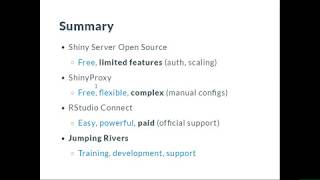 18mDeploy R and Shiny
 20mWhat I learned from running Shiny in production
 25mReproducibility Around a Web Application
 20mShiny in Action: Transforming Film Production with TARS
 40mPHP and R - Putting the PoweR in PHP Statistics
 22mUsing Python & R in Harmony
 34mLightning Talks
 37mA Shiny application for job matching