A Crash Course in Applied Linear Algebra

summary
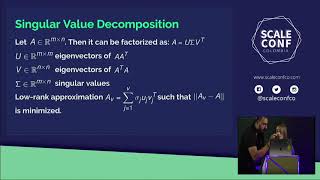
Shows concrete claims and runnable tools: y = Ax decomposition as a unifying model, practical demos in NumPy, and when low matrix rank yields compression and speedups. Explains singular value decomposition and the Moore–Penrose pseudo-inverse with exact interpretations (least squares or minimum-norm solutions). Uses eigenvalues to predict stability and Markov chains to illustrate steady states, and builds a control example that steers a 2D head to a target with no overshoot.
AI-written summary · about
chapters (9)
- 0:00Linear algebra in data prediction
- 1:50Why linear algebra matters
- 8:27Matrix rank applications
- 12:23Eigenvalues and eigenvectors
- 17:02Markov chains and evolution
- 22:39Singular value decomposition
- 26:32Pseudoinverse practical uses
- 30:34Hard disk control problem
- 33:43Summary
related talks
 32mA Primer (or Refresher) On Linear Algebra for Data Science
 32mRandomized Numerical Linear Algebra: Overview
 01h 00mAdventures in Linear Algebra++ and Unsupervised Learning
 01h 03mSampling for Linear Algebra, Statistics, and Optimization I
 01h 31mPast, Present and Future of Randomized Numerical Linear Algebra II
 34mThe Linear Algebra of Deep Learning
 43mThe Linear Algebra of Deep Learning
 48mMathematics for Developers