Adventures in Linear Algebra++ and Unsupervised Learning

summary
Explores connections between advanced linear algebra techniques and unsupervised learning, focusing on how linear-algebraic tools can be used to design or analyze algorithms for unsupervised tasks. Discusses specific mathematical frameworks and methods from linear algebra that inform algorithmic approaches in unsupervised learning.
AI-written summary · about
chapters (17)
- 0:00Intro
- 1:04Is NP-hardness an obstacle for theory?
- 3:59Classical Lin. Algebra: least square variants
- 4:41Semi-classical linear algebra
- 12:06Tensor variants of spectral methods
- 14:03Main paradigm for unsupervised Learning
- 16:46Inverse Moment Problem
- 18:49Topic Models
- 19:37"Bag of words" Assumption in Text Analysis
- 20:33Hidden Variable Explanation
- 40:17Ex 3: Dictionary Learning (aka Sparse Coding)
- 41:59Why dictionary learning? Olshausen Field '96
- 44:53"Energy minimization" heuristic
- 50:09Understanding "randomly-wired" deep nets
- 53:36Example of a useful ingredient
- 54:56Open Problems (LinAL++)
- 56:56Open Problems (ML)
related talks
 32mA Primer (or Refresher) On Linear Algebra for Data Science
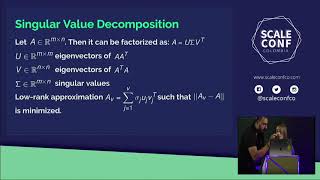 34mThe Linear Algebra of Deep Learning
 35mA Crash Course in Applied Linear Algebra
 01h 02mTheory and Big Data
 32mRandomized Numerical Linear Algebra: Overview
 43mThe Linear Algebra of Deep Learning
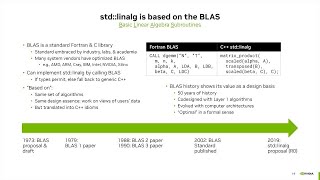 01h 15mstd::linalg: Linear Algebra Coming to Standard C++
 01h 03mSampling for Linear Algebra, Statistics, and Optimization I